
Hendrix came and went as I was developing into a teen and getting interested in music. Though we had some of his early singles in the house (I recall with great fondness playing "Hey Joe" over and over), I first really became aware of him when he died and "Voodoo Chile / Child" was released as a single. I did not fall in love with that record. It puzzled me somewhat. I was familiar with the fuzzy guitar sound, as "Spirit In The Sky", that stunning one-off hit single by the unknown and mysterious Norman Greenbaum, had been No 1 earlier in the year, but while aspects of the guitar playing were attractive, the song as a whole struck me as something of a mess - a little too jazzy, and utilising what (for me at the time) were old fashioned and boring blues riffs. It lacked direction, energy, harmony, etc. There were musical sounds, but they seemed to serve little purpose. I find out later that it's simply an ad-hoc jam for the cameras around the more developed 15 minute "Voodoo Chile", and by that time I have fallen in love with it. I do see the melody and the pop in it. But at 14, I balked against it, and it tended to set me against Hendrix. When friends urged Hendrix onto me, especially the live stuff, there were bits I really dug, but I pushed constantly against the notion that Hendrix was a great, innovative, and influential guitar player. For me he was a curious blend of Chitlin Circuit showmanship and Eric Clapton clone. I have come round to respecting and liking Hendrix more today, though I'm not (yet?) at the stage of regarding him as Wikipedia says: "one of the greatest and most influential guitarists in the history of popular music". There is, for me, a considerable list of guitar players who stand in line before Hendrix, and whose influences can he heard in Hendrix's playing - Eric Clapton, Chuck Berry, etc.
Wikipedia:
James Marshall "Jimi" Hendrix (born Johnny Allen Hendrix; November 27, 1942 – September 18, 1970) was an American guitarist, songwriter and singer. He is widely regarded as one of the greatest and most influential guitarists in the history of popular music. Inducted into the Rock and Roll Hall of Fame in 1992 as a part of his band, the Jimi Hendrix Experience, the institution describes him as "arguably the greatest instrumentalist in the history of rock music."[1]
Born in Seattle, Washington, Hendrix began playing guitar at age 15. In 1961, he enlisted in the US Army, but was discharged the following year. Soon afterward, he moved to Clarksville, then Nashville, Tennessee, and began playing gigs on the chitlin' circuit, earning a place in the Isley Brothers' backing band and later with Little Richard, with whom he continued to work through mid-1965. He then played with Curtis Knight and the Squires.
Hendrix moved to England in late 1966, after bassist Chas Chandler of the Animals became his manager. Within months, he had formed his band, the Jimi Hendrix Experience (with its rhythm section consisting of bassist Noel Redding and drummer Mitch Mitchell), and achieved three UK top ten hits: "Hey Joe", "Purple Haze", and "The Wind Cries Mary". He achieved fame in the US after his performance at the Monterey Pop Festival in 1967. His third and final studio album, Electric Ladyland (1968), became his most commercially successful release and his only number one album on the US Billboard 200 chart. The world's highest-paid rock musician,[2] Hendrix headlined the Woodstock Festival in 1969 and the Isle of Wight Festival in 1970. He died in London from barbiturate-related asphyxia in September 1970, at the age of 27.
Hendrix was inspired by American rock and roll and electric blues. He favored overdriven amplifiers with high volume and gain, and was instrumental in popularizing the previously undesirable sounds caused by guitar amplifier feedback. He was also one of the first guitarists to make extensive use of tone-altering effects units in mainstream rock, such as fuzz distortion, Octavia, wah-wah, and Uni-Vibe. He was the first musician to use stereophonic phasing effects in recordings. Holly George-Warren of Rolling Stone commented: "Hendrix pioneered the use of the instrument as an electronic sound source. Players before him had experimented with feedback and distortion, but Hendrix turned those effects and others into a controlled, fluid vocabulary every bit as personal as the blues with which he began."[3]
Hendrix had an "undesirable" discharge from the army for neglecting his duties to play guitar and masturbate. Hendrix himself claimed he had an honourable discharge because he hurt his ankle in a parachute jump, but the army records show that was not the case.
Jimi Hendrix Biography by Richie Unterberger
In his brief four-year reign as a superstar, Jimi Hendrix expanded the vocabulary of the electric rock guitar more than anyone before or since. Hendrix was a master at coaxing all manner of unforeseen sonics from his instrument, often with innovative amplification experiments that produced astral-quality feedback, and roaring distortion. His frequent hurricane blasts of noise and dazzling showmanship -- he could and would play behind his back and with his teeth, and set his guitar on fire -- have sometimes obscured his considerable gifts as a songwriter, singer, and master of a gamut of blues, R&B, and rock styles.
When Hendrix became an international superstar in 1967, it seemed as if he'd dropped out of a Martian spaceship, but in fact he'd served his apprenticeship in numerous R&B acts on the chitlin circuit. During the early and mid-'60s, he worked with such R&B/soul greats as Little Richard, the Isley Brothers, and King Curtis as a backup guitarist. Occasionally, he recorded as a sessionman (the Isley Brothers' 1964 single "Testify" is the only one of these early tracks that offers even a glimpse of his future genius). For the most part, his bosses didn't appreciate his show-stealing showmanship, and Hendrix was straitjacketed by sideman roles that didn't allow him to develop as a soloist. The logical step was for him to go out on his own, which he did in New York in the mid-'60s, playing with various musicians in local clubs, and joining white blues-rock singer John Hammond, Jr.'s band for a while.
It was in a New York club that Hendrix was spotted by Animals bassist Chas Chandler. The first lineup of the Animals was about to split, and Chandler, looking to move into management, convinced Hendrix to move to London and record as a solo act in England. There a group was built around Jimi -- featuring Mitch Mitchell on drums and Noel Redding on bass -- that was dubbed the Jimi Hendrix Experience. The trio became stars with astonishing speed in the U.K., where "Hey Joe," "Purple Haze," and "The Wind Cries Mary" all made the Top Ten in the first half of 1967. These tracks were also featured on their debut album, Are You Experienced?, a psychedelic masterwork that became a huge hit in the U.S. after Hendrix created a sensation at the Monterey Pop Festival in June of 1967.
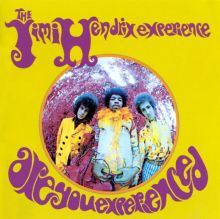
Are You Experienced? was an astonishing debut, particularly from a young R&B veteran who had rarely sung, and apparently never written his own material before the Experience formed. What caught most people's attention at first was his virtuosic guitar playing, which employed an arsenal of devices, including wah-wah pedals, buzzing feedback solos, crunching, distorted riffs, and lightning-quick liquid runs up and down the scales. Hendrix was also a first-rate songwriter, melding cosmic imagery with some surprisingly pop-savvy hooks and tender sentiments. Are You Experienced? was psychedelia at its most eclectic, synthesizing mod pop, soul, R&B, Dylan, and the electric guitar innovations of British pioneers like Jeff Beck, Pete Townshend, and Eric Clapton.
Amazingly, Hendrix would only record three fully conceived studio albums in his lifetime. Axis: Bold as Love and the double-LP Electric Ladyland were more diffuse and experimental than Are You Experienced? On Electric Ladyland in particular, Hendrix pioneered the use of the studio itself as a recording instrument, manipulating electronics and devising overdub techniques (with the help of engineer Eddie Kramer in particular) to plot uncharted sonic territory.
"Testify" - The Isley Brothers, 1964 - first known recording of Hendrix. Typical blue based, fast, heavy, flashy Hendrix guitar work with nice funky chops.
"Mercy Mercy" - Don Covay and the Goodtimers, May 1964. Possible guitar by Hendrix. Hendrix claimed it was him to Steve Cropper, but there's no documented evidence, and conflicting statements by those who were present at the recording. At this time, Hendrix was touring with the Isley's, but briefly dropped out of the tour, and when he rejoined they had to buy him a new guitar because he said his had been stolen. Hendrix is known to have pawned his own guitars when short of money, and is also known to have lied about events. An unknown guitarist stepping in at short notice, without a guitar, to play a sophisticated guitar part in the style of the band's regular guitarist, sounds a bit far fetched. Though if Hendrix lied about his guitar being stolen, and he had his guitar at the time, and the regular guitarist was ill, then the story becomes a little more plausible, though still stretches credulity. He might have played one of the two rhythm guitars heard on the right and left of the mix. The most plausible lead guitarist is Jimmy Johnson who went on to be part of the Muscle Shoals band who played on Aretha Franklin and Wilson Picket tracks. The lead guitar part is delicate, country influenced, with trills not heard on other Hendrix tracks.
"Shotgun" - Buddy & Stacey with Little Richard's backing band, The Upsetters, on Night Train, May 1965 - first known TV appearance of Hendrix
Rosa Lee Brooks - My Diary, 1965. Typical Hendrix guitar at the start.
 |
| Are You Experienced (1967 - US version) |
| Released | May 12, 1967 |
|---|---|
| Recorded | October 23, 1966 – April 4, 1967 |
| Studio | De Lane Lea, CBS, & Olympic, London |
| Genre | |
| Length |
|
| Label | |
| Producer | Chas Chandler |
All tracks written by Jimi Hendrix, except where noted.
| No. | Title | Length |
|---|---|---|
| 1. | "Purple Haze" | 2:46 |
| 2. | "Manic Depression" | 3:30 |
| 3. | "Hey Joe" (Billy Roberts) | 3:23 |
| 4. | "Love or Confusion" | 3:15 |
| 5. | "May This Be Love" | 2:55 |
| 6. | "I Don't Live Today" | 3:55 |
| No. | Title | Length |
|---|---|---|
| 1. | "The Wind Cries Mary" | 3:21 |
| 2. | "Fire" | 2:34 |
| 3. | "Third Stone from the Sun" (US edition spelling) | 6:40 |
| 4. | "Foxey Lady" (US edition spelling) | 3:15 |
| 5. | "Are You Experienced?" | 3:55 |
| Total length: | 39:29 | |
| No. | Title | Length |
|---|---|---|
| 12. | "Stone Free" | 3:36 |
| 13. | "51st Anniversary" | 3:15 |
| 14. | "Highway Chile" | 3:32 |
| 15. | "Can You See Me" | 2:33 |
| 16. | "Remember" | 2:48 |
| 17. | "Red House" | 3:50 |
| Total length: | 19:34 | |
Wikipedia:
AllMusic:
Score:
 |
| Axis: Bold as Love (1967) |
All songs written by Jimi Hendrix, except where noted.
| No. | Title | Length |
|---|---|---|
| 1. | "EXP" | 1:55 |
| 2. | "Up from the Skies" | 2:55 |
| 3. | "Spanish Castle Magic" | 3:00 |
| 4. | "Wait Until Tomorrow" | 3:00 |
| 5. | "Ain't No Telling" | 1:46 |
| 6. | "Little Wing" | 2:24 |
| 7. | "If Six Was Nine" (US edition spelling "If 6 Was 9") | 5:32 |
| No. | Title | Length |
|---|---|---|
| 1. | "You've Got Me Floating" (US edition spelling "You Got Me Floatin'") | 2:45 |
| 2. | "Castles Made of Sand" | 2:46 |
| 3. | "She's So Fine" (Noel Redding) | 2:37 |
| 4. | "One Rainy Wish" | 3:40 |
| 5. | "Little Miss Lover" | 2:20 |
| 6. | "Bold as Love" | 4:09 |
| Total length: | 38:49 | |
Wikipedia
AllMusic
Score:
 |
| Smash Hits (1968) Compilation |
| No. | Title | Original release | Length |
|---|---|---|---|
| 1. | "Purple Haze" | single | 2:44 |
| 2. | "Fire" | Are You Experienced | 2:35 |
| 3. | "The Wind Cries Mary" | single | 3:21 |
| 4. | "Can You See Me" | Are You Experienced | 2:33 |
| 5. | "51st Anniversary" | single (UK B-side) | 3:18 |
| 6. | "Hey Joe" (Billy Roberts) | single | 3:26 |
| No. | Title | Original release | Length |
|---|---|---|---|
| 1. | "Stone Free" | single (UK B-side) | 3:39 |
| 2. | "The Stars That Play with Laughing Sam's Dice" | single (UK B-side) | 4:22 |
| 3. | "Manic Depression" | Are You Experienced | 3:36 |
| 4. | "Highway Chile" | single (UK B-side) | 3:32 |
| 5. | "Burning of the Midnight Lamp" | single (UK) | 3:38 |
| 6. | "Foxy Lady" | Are You Experienced | 3:18 |
Wikipedia
AllMusic:
Score:
 |
| Electric Ladyland (1968) |
All songs are written by Jimi Hendrix, except where noted.
| No. | Title | UK title (where different)[69] | Length |
|---|---|---|---|
| 1. | "... And the Gods Made Love" | "And the Gods Made Love" (no ellipsis) | 1:19 |
| 2. | "Have You Ever Been (To Electric Ladyland)" | 2:08 | |
| 3. | "Crosstown Traffic" | "Cross Town Traffic" | 2:25 |
| 4. | "Voodoo Chile" | 14:50 |
| No. | Title | UK title (where different)[69] | Length |
|---|---|---|---|
| 1. | "Little Miss Strange" (Noel Redding) | 2:47 | |
| 2. | "Long Hot Summer Night" | 3:21 | |
| 3. | "Come On (Part 1)" (Earl King) | "Come On" | 4:04 |
| 4. | "Gypsy Eyes" | "Gipsy Eyes" | 3:38 |
| 5. | "Burning of the Midnight Lamp" | "The Burning of the Midnight Lamp" | 3:33 |
| No. | Title | UK title (where different)[69] | Length |
|---|---|---|---|
| 1. | "Rainy Day, Dream Away" | 3:39 | |
| 2. | "1983....(A Merman I Should Turn to Be)" | Three ellipses instead of four | 13:25 |
| 3. | "Moon, Turn the Tides....Gently Gently Away" | Three ellipses instead of four | 0:58 |
| No. | Title | UK title (where different)[69] | Length |
|---|---|---|---|
| 1. | "Still Raining, Still Dreaming" | 4:19 | |
| 2. | "House Burning Down" | 4:26 | |
| 3. | "All Along the Watchtower" (Bob Dylan) | 3:54 | |
| 4. | "Voodoo Child (Slight Return)" | "Voodoo Chile (Slight Return)" | 5:06 |
| Total length: | 73:56 | ||
Wikipedia
AllMusic:
Score:
 |
| Band of Gypsys (1970; live) |
All tracks were written by Jimi Hendrix, except "Changes" and "We Gotta Live Together" by Buddy Miles, and "Stop" by Jerry Ragovoy and Mort Shuman.
| No. | Title | Lead vocals | Length |
|---|---|---|---|
| 1. | "Who Knows" (3rd show) | Jimi Hendrix, Buddy Miles | 9:34 |
| 2. | "Machine Gun" (3rd show) | Hendrix, Miles | 12:38 |

| Released | March 5, 1971 |
|---|---|
| Recorded | March 1968 – August 1970 |
| Studio |
|
| Genre | |
| Length | 39:48 |
| Label | Polydor/Track (UK) Reprise (US) |
| Producer |
|
All tracks are written by Jimi Hendrix..
| No. | Title | Length |
|---|---|---|
| 1. | "Freedom" | 3:24 |
| 2. | "Drifting" | 3:46 |
| 3. | "Ezy Ryder" | 4:09 |
| 4. | "Night Bird Flying" | 3:50 |
| 5. | "My Friend" | 4:40 |
| No. | Title | Length |
|---|---|---|
| 1. | "Straight Ahead" | 4:42 |
| 2. | "Astro Man" | 3:37 |
| 3. | "Angel" | 4:25 |
| 4. | "In from the Storm" | 3:42 |
| 5. | "Belly Button Window" | 3:34 |
- Jimi Hendrix – lead vocals, guitars; piano on "Freedom"; backing vocals on "In From the Storm"; production, mixing on "Freedom," "Ezy Rider," Nightbird Flying," "Astro Man," and "Belly Button Window"
- Billy Cox – bass guitar all tracks except "My Friend" and "Belly Button Window"
- Mitch Mitchell – drums all tracks except "Ezy Ryder," "My Friend," and "Belly Button Window"; posthumous production and mixing on "Angel"
Additional musicians
- Juma Sultan – percussion on "Freedom" and "Astro Man"
- The Ghetto Fighters a.k.a. Arthur and Albert Allen – backing vocals on "Freedom"
- Buzzy Linhart – vibraphone on "Drifting"
- Buddy Miles – drums on "Ezy Rider"
- Billy Armstrong – percussion on "Ezy Rider"
- Steve Winwood, Chris Wood – backing vocals on "Ezy Rider"
- Kenny Pine – twelve-string guitar on "My Friend"
- Stephen Stills – piano on "My Friend" (uncredited)
- Noel Redding – bass guitar on "My Friend"
- Jimmy Mayes – drums on "My Friend"
- Paul Caruso a.k.a. Gers – harmonica on "My Friend"
- Emeretta Marks – backing vocals on "In From the Storm"

All tracks are written by Jimi Hendrix, except "Star Spangled Banner", written by Francis Scott Key
| No. | Title | Recording date | Length |
|---|---|---|---|
| 1. | "Dolly Dagger" | June - Aug, 1970 | 4:45 |
| 2. | "Earth Blues" | Dec 19, 1969; Jan 20 & June 26, 1970 | 4:20 |
| 3. | "Pali Gap" | July 1, 1970 | 5:05 |
| 4. | "Room Full of Mirrors" | Nov 17 1969; June - Aug, 1970 | 3:17 |
| 5. | "Star Spangled Banner" (studio) | March 18, 1969 | 4:07 |
| Total length: | 21:34 | ||
| No. | Title | Recording date | Length |
|---|---|---|---|
| 1. | "Look Over Yonder" | Oct 22, 1968 | 3:28 |
| 2. | "Hear My Train A Comin'" (live) | May 30, 1970 | 11:15 |
| 3. | "Hey Baby (New Rising Sun)" | July 1, 1970 | 6:05 |
| Total length: | 20:48 | ||
Score:
 |
| War Heroes (1972) |
The third posthumous compilation to use tracks that were being recorded for the uncompleted fourth Hendrix studio album. This also has earlier tracks.
All tracks written by Jimi Hendrix, except where noted.
| No. | Title | Recording date | Length |
|---|---|---|---|
| 1. | "Bleeding Heart" | March 24, 1970 | 3:15 |
| 2. | "Highway Chile" | April 3, 1967 | 3:30 |
| 3. | "Tax Free" (Bo Hansson, Janne Carlsson) | May 1, 1968 | 4:58 |
| 4. | "Peter Gunn" (Henry Mancini) | May 14, 1970 | 2:18 |
| 5. | "Stepping Stone" | November 14, 1969 | 4:07 |
| No. | Title | Recording date | Length |
|---|---|---|---|
| 1. | "Midnight" | April 3, 1969 | 5:32 |
| 2. | "3 Little Bears" | May 2, 1968 | 4:09 |
| 3. | "Beginning" (Mitch Mitchell) | June 16 and/or July 1, 1970 | 4:13 |
| 4. | "Izabella" | August 28 and 29, 1969 | 2:55 |
- Jimi Hendrix – guitars, vocals
- Mitch Mitchell – drums
- Billy Cox – bass guitar on "Bleeding Heart", "Peter Gunn Catastrophe", "Stepping Stone", "Beginning", and "Izabella"
- Noel Redding – bass guitar on "Highway Chile", "Tax Free", "Midnight", and "3 Little Bears"
Score:
 |
Hendrix In The West (1972) Live compilation |
| No. | Title | Venue/date | Length |
|---|---|---|---|
| 1. | "The Queen" (Traditional) | Isle of Wight, 8/31/70 | 2:59 |
| 2. | "Sgt. Pepper's Lonely Hearts Club Band" (Beatles) | Isle of Wight, 8/31/70 | 0:50 |
| 3. | "Little Wing" * | Royal Albert Hall, 2/24/69 | 3:13 |
| 4. | "Red House" | San Diego Sports Arena, 5/24/69 | 13:12 |
| No. | Title | Venue/date | Length |
|---|---|---|---|
| 1. | "Johnny B. Goode" (Chuck Berry) | Berkeley Community Theatre, 5/30/70 | 4:45 |
| 2. | "Lover Man" | Berkeley Community Theatre, 5/30/70 | 3:05 |
| 3. | "Blue Suede Shoes" (Carl Perkins) | Berkeley Community Theatre, 5/30/70 | 4:31 |
| 4. | "Voodoo Child (Slight Return)" | Royal Albert Hall, 2/24/69 | 7:55 |
- Jimi Hendrix – guitar, vocals
- Mitch Mitchell – drums
- Noel Redding – bass guitar (1968–1969 tracks)
- Billy Cox – bass guitar (1970 tracks)
Score:
Loose Ends (1974)
Crash Landing (1975)
Midnight Lightning (1975)
Nine to the Universe (1980)
Radio One (1988)
South Saturn Delta (1997)
Valleys of Neptune (2010)

No comments:
Post a Comment
Comments welcome